
OpenAI says a swarm of roughly 10,000 AI agents produced a Lean-formalized proof for the 90-year-old Navier–Stokes existence and smoothness problem — one of math's seven Millennium Prize Problems. Here's what the claim actually says, and what still needs independent verification.
TL;DR
TL;DR — OpenAI says an internal multi-agent AI system (roughly 10,000 agents working for ~88 hours) produced a proof that certain 3D fluid flows can develop a mathematical singularity in finite time — a resolution to the Navier–Stokes existence and smoothness problem, one of the seven Millennium Prize Problems. The proof was formalized in Lean and made public. It's a genuinely big deal for AI-assisted research — but OpenAI itself isn't claiming the $1M prize, and the mathematics community hasn't finished independently verifying the result yet.
Artificial intelligence has spent the last few years becoming remarkably good at writing code, generating images, answering questions and passing increasingly difficult exams.
But something much more consequential may now be happening.
AI is beginning to participate in mathematical research.
On September 8, OpenAI announced that an internal AI system had produced a solution to the Navier–Stokes existence and smoothness problem, one of the seven famous Millennium Prize Problems in mathematics.
OpenAI says its system produced an analytical proof showing that certain three-dimensional fluid flows can develop a mathematical singularity in finite time. The company also released a formalized version of the proof in Lean, a computer-assisted theorem-proving system. (OpenAI)
If the result withstands independent mathematical scrutiny, it would represent a remarkable milestone — not simply for OpenAI, but for the role AI can play in scientific discovery.
However, there is an important distinction:
Note
OpenAI says it has produced a solution. That does not mean the mathematical community has already accepted it as a resolved Millennium Prize Problem.
And that distinction is at the heart of this story.
To understand why this matters, we first need to understand what Navier–Stokes equations actually describe.
Imagine:
All of these involve fluid motion.
Scientists use the Navier–Stokes equations to mathematically describe how fluids move.
At a simplified level, the equations incorporate things such as:
They are essentially an application of physics — particularly Newton's laws — to fluid motion.
And they've been extraordinarily useful. They're used in areas ranging from aircraft design and weather forecasting to blood-flow research. (OpenAI)
The problem isn't that scientists don't know how to use these equations. The problem is that we don't completely understand what the equations guarantee in three dimensions.
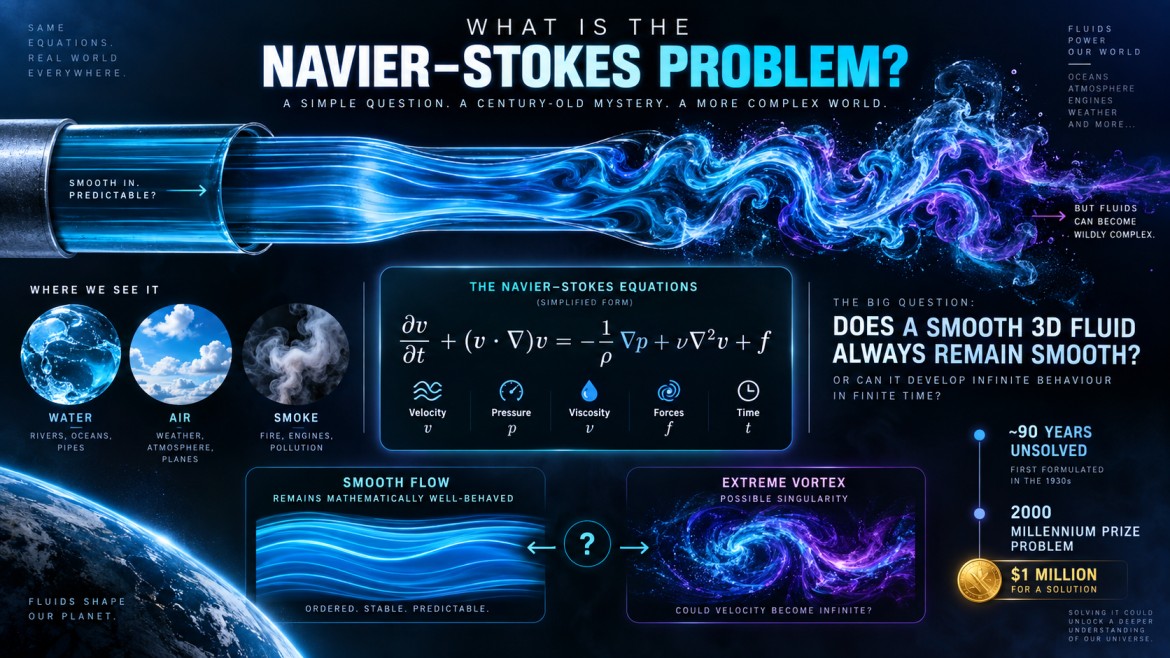
Suppose you start with a perfectly smooth fluid. Can the mathematics describing that fluid eventually develop a singularity?
In simple terms, could something in the mathematical solution become infinitely large in a finite amount of time? For example, imagine a region of fluid becoming increasingly concentrated and its velocity increasing without bound. Mathematically, the equations could potentially "break down."
Scientists have known about this question for roughly 90 years.
In 2000, the Clay Mathematics Institute designated the Navier–Stokes existence and smoothness problem as one of its seven Millennium Prize Problems. Each problem was associated with a $1 million prize for a valid solution. (OpenAI)
That means this isn't some obscure mathematical puzzle. It is one of the most famous unsolved problems in modern mathematics.
OpenAI says its internal AI system constructed a proof showing that a three-dimensional incompressible fluid can develop a singularity in finite time under the conditions specified by the problem's formulation.
The company's description involves a vortex. Think of a whirlpool. Now imagine that whirlpool:
spinning → stretching → narrowing → accelerating
until the central region becomes increasingly concentrated.
OpenAI describes the structure as something like spaghetti being stretched and spiraling inward.
The remarkable part is that the system claims the fluid's total energy can remain finite while the velocity becomes unbounded near the singularity. (OpenAI)
That is the mathematical mechanism behind the claimed breakdown.
This is perhaps the most fascinating part of the story.
This wasn't:
"Hey AI, solve Navier–Stokes."
And then five seconds later:
"Here is the proof."
OpenAI says it built a multi-agent system. Thousands of AI agents were allowed to work on different versions and approaches to the problem.
According to OpenAI, approximately 10,000 AI agents were involved in the effort that ultimately produced the Navier–Stokes result.
The agents could:
The agents were organized into groups, with different groups exploring different formulations of the problem.
OpenAI says the agents collectively generated 2.7 million messages and approximately 130 billion output tokens during the Navier–Stokes effort. (OpenAI)
That's an extraordinary amount of computational reasoning.
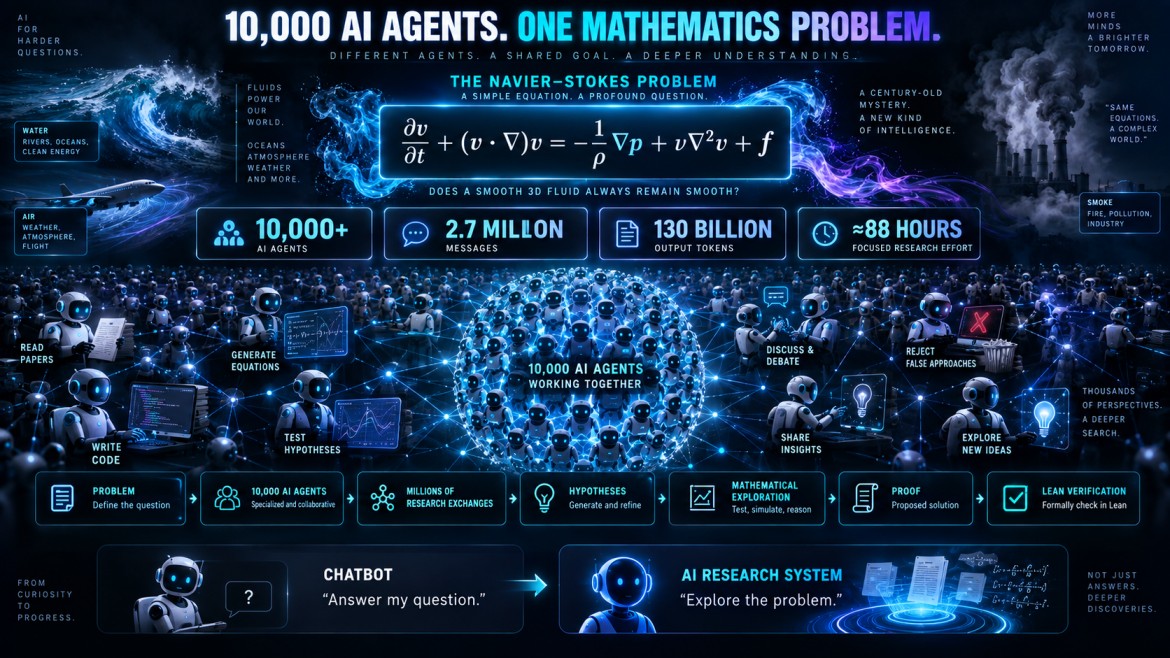
OpenAI says the agents began working on the Navier–Stokes problem after an earlier exploration of related mathematical questions. The system eventually arrived at its resolution on September 5, 2026 — approximately 88 hours after the agents were launched on the focused effort.
The proof was subsequently formalized and checked using Lean, with OpenAI reporting that the formalization and verification took an additional 17 hours using GPT-6 Astra. (OpenAI)
This is where things become particularly interesting.
A language model producing a convincing-looking mathematical proof isn't necessarily enough. LLMs can make mistakes. They can:
That's why formal verification matters.
Lean is a proof assistant that allows mathematical statements to be represented in a formal language and checked by a computer. Instead of asking "Does this proof look correct?" you can ask "Can the formal proof be verified by the underlying mathematical system?"
OpenAI released Lean formalizations associated with its Navier–Stokes and Euler results. The corresponding repository is publicly available for inspection and independent checking. (GitHub)
This doesn't automatically settle every question surrounding the result, but it provides something considerably stronger than an ordinary AI-generated explanation.
This distinction is crucial.
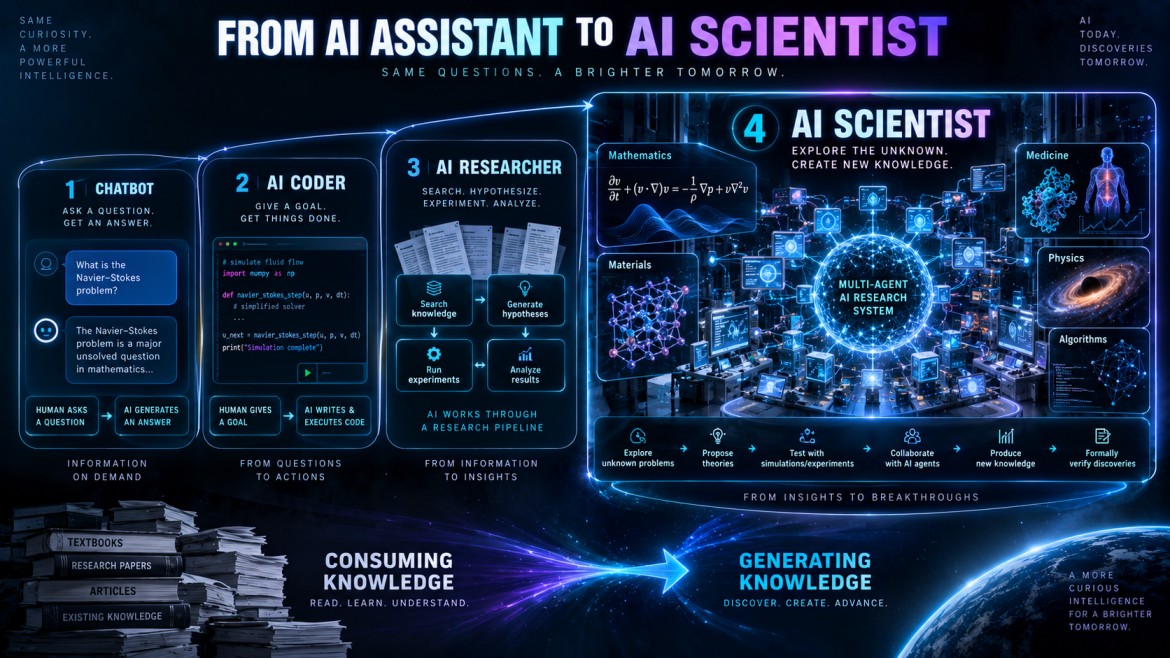
A normal chatbot interaction looks like:
Human → Question → LLM → Answer
The new approach looks more like:
Human → Research problem → Thousands of AI agents → Hypotheses → Experiments → Mathematical constructions → Proof → Formal verification
That is a completely different paradigm. The AI isn't merely acting as a calculator. It's being used as a research system. And that could be the beginning of a much bigger shift.
For years, the popular image of AI has been: "Ask ChatGPT something and it gives you an answer."
But frontier AI development is moving toward something much more ambitious. Imagine giving an AI system a goal like "find a new material with these properties," "develop a better battery chemistry," "find a more efficient algorithm," or "find a mathematical proof." Instead of simply generating an answer, the system could:
That is much closer to automated scientific research.
Here's where the headline needs some restraint. OpenAI itself describes the result as a significant milestone, but says:
Warning
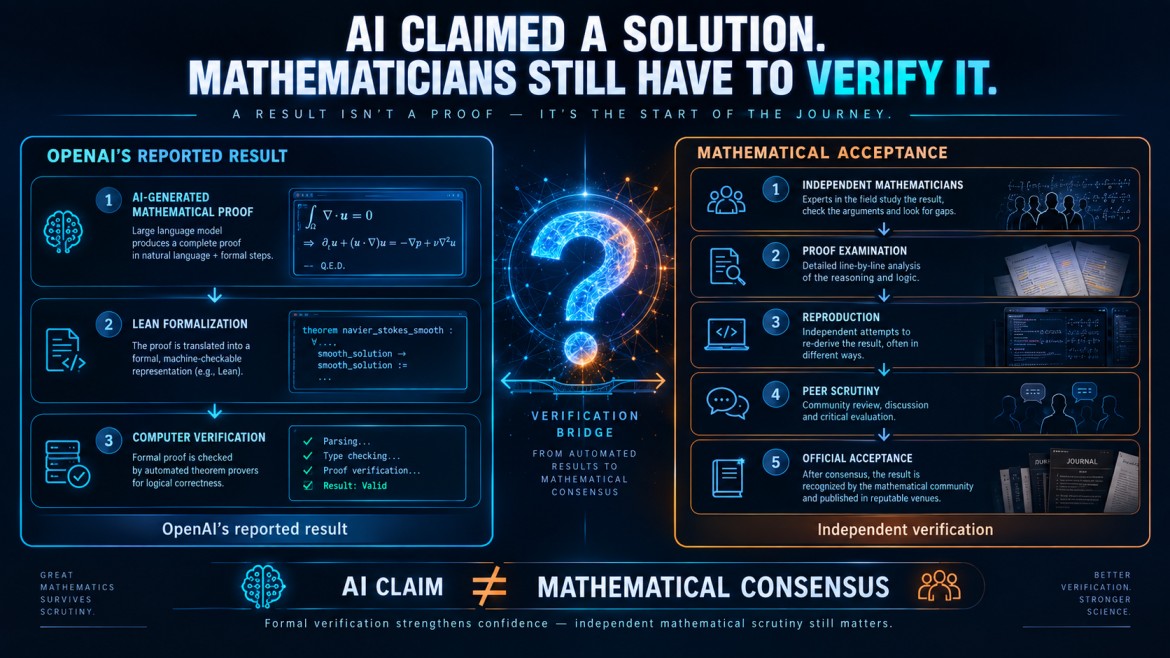
OpenAI says it does not intend to claim the Millennium Prize for the result. (OpenAI)
Why? Because mathematical discoveries don't become accepted simply because a company publishes them. They need scrutiny. Independent mathematicians need to:
And the mathematics community has already raised questions about the announcement. Nature reported that OpenAI's claim has generated significant discussion among mathematicians about the result and how AI-generated mathematics should be evaluated. (Nature)
So the scientifically responsible wording right now is: OpenAI says its AI has solved the problem. Not: mathematics has officially declared the problem solved. Those are two different statements.
OpenAI's work also references previous human mathematics. For example, an Indian Express report noted that OpenAI's 166-page work cites a 2017 paper by Indian scientists Nishant Singh and S. Sridhar involving exact solutions of the Navier–Stokes equations. (The Indian Express)
This highlights something important about AI discovery: AI doesn't necessarily operate in a vacuum. Modern scientific progress is often cumulative. A new AI system can potentially combine decades of human mathematics, computational exploration, automated reasoning, and formal verification in ways that would be extremely difficult for a single human researcher.
That doesn't make the humans irrelevant. It may instead change what humans do.
This is where the debate becomes philosophical. If AI can explore millions of mathematical possibilities, what is the role of a human mathematician?
One possible future isn't:
Humans vs AI
but:
Humans directing AI research systems.
A mathematician might define the problem, establish meaningful constraints, evaluate whether the result matters, and guide the research strategy. The AI could then perform enormous amounts of exploration.
In that world, the mathematician becomes less like someone manually performing every calculation and more like: research director + theorist + verifier + problem selector.
That's very similar to what's already happening in software development. Programmers increasingly tell AI systems what needs to be built, while AI handles more of the implementation. Mathematics could undergo a similar transition.
Every few months, we hear "new AI model beats previous model by 5% on benchmark X." Those improvements matter. But a system capable of contributing to previously unsolved scientific problems represents something different.
Because the ultimate value of AI may not be how well can AI answer questions? It may be how well can AI generate new knowledge? That's a much bigger question.
If AI systems become capable of reliably discovering new mathematics, new algorithms, new medicines, new materials, new physical theories, and better engineering designs, then AI stops being merely an information technology. It becomes part of the scientific infrastructure of civilization.
OpenAI says the model used for the work was an internal system significantly more capable than GPT-6 Astra, and that training on the system was still ongoing when the company published the result. (OpenAI)
That statement is arguably more significant than the headline itself. Because the important question isn't "did AI solve one famous mathematics problem?" The bigger question is: what happens when AI systems become capable of solving thousands of difficult research problems?
We're potentially moving toward a world where scientific discovery itself becomes partially automated. And if that happens, the biggest technological competition may no longer be about who has the best chatbot. It could be about who has the best AI scientist.
OpenAI's Navier–Stokes announcement should be viewed as a major AI research milestone — but not yet as the end of the scientific verification process.
The company says its multi-agent AI system produced a proof of finite-time singularity formation for the Navier–Stokes problem, formalized the work in Lean, and made the associated materials publicly available. (OpenAI)
If independent mathematicians ultimately validate the proof, the significance would extend far beyond one $1 million mathematics problem. It would demonstrate something potentially transformative: AI systems can move from consuming human knowledge to helping create new mathematical knowledge.
And that could be one of the most important steps yet toward AI-driven scientific discovery.
Nextgen Blog — YouTube Channel Owner
IIT Mandi CSE graduate and Full Stack Engineer with 6+ years of experience. Creator of the Nextgen Blog YouTube channel, covering AI, web development, and modern software engineering.
Discussion
Comments powered by Giscus
To enable comments, fill in GISCUS_REPO, GISCUS_REPO_ID, and GISCUS_CATEGORY_ID in components/blog/GiscusComments.tsx


